Rethinking the Query: The Rise of AI-Enabled Web Search
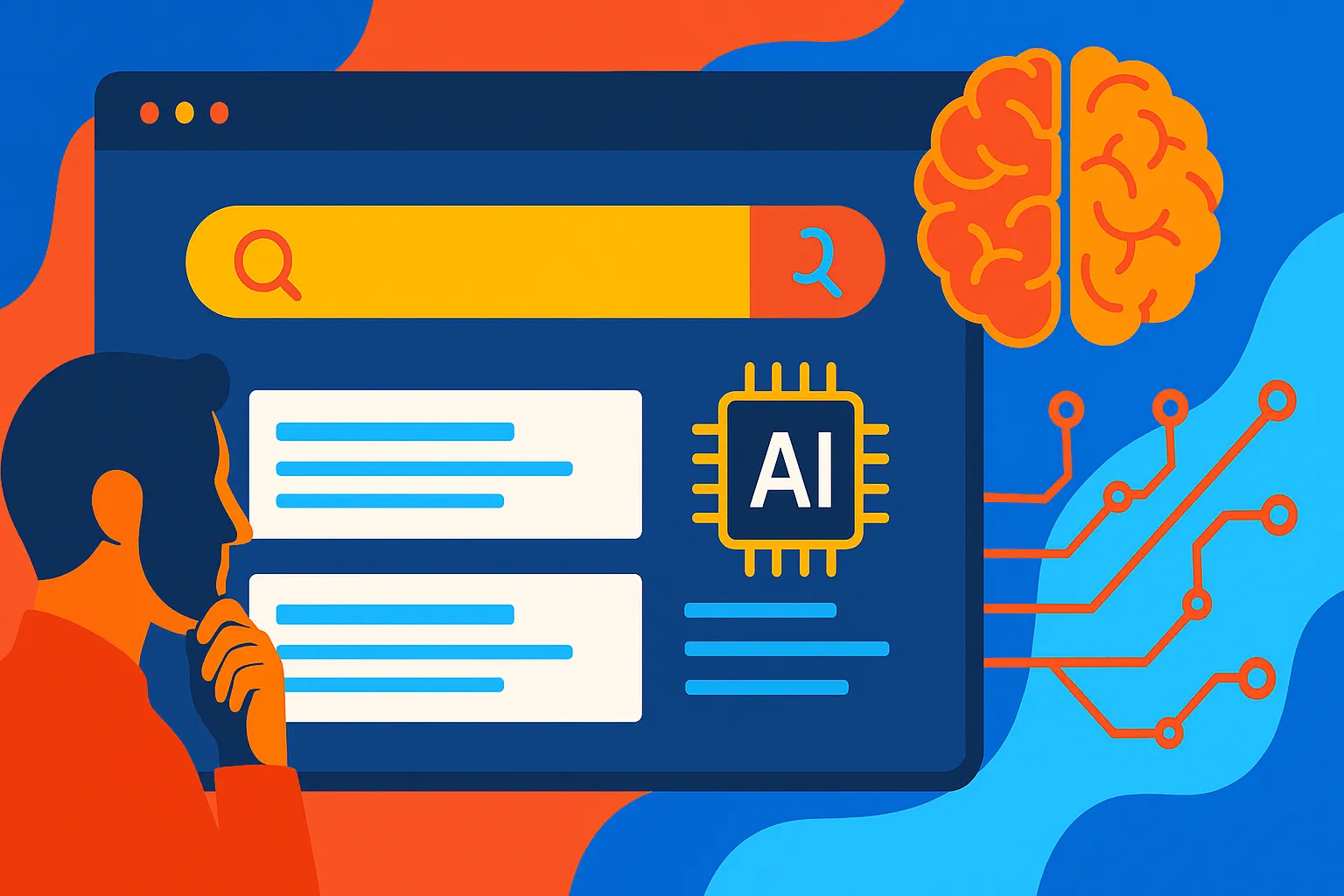
How generative AI is transforming the way we find, consume, and act on information
AI-enabled web search refers to the use of artificial intelligence, especially large language models (LLMs), to deliver search results in a more conversational, contextual, and direct way. Instead of offering a ranked list of links like traditional search engines, AI-powered search engines synthesize and generate responses, making them feel more like expert assistants than digital librarians.
Here are further comparisons of the two:
-
Traditional search engines respond with a list of links and snippets, while AI-enabled search provides direct, conversational answers. Traditional systems retrieve existing pages, whereas AI systems synthesize content from multiple sources. The former relies heavily on keyword matching, while the latter understands natural language and user intent.
-
When it comes to context, traditional search treats each query as standalone. In contrast, AI-enabled search can maintain context across a conversation, making follow-up questions more seamless. Additionally, while traditional search primarily uses text input and output, modern AI tools increasingly support images, voice, and multimodal interactions.
-
Personalization is also deeper with AI. Traditional search might offer basic personalization (like adjusting for location or past searches), but AI-enabled systems can be highly context-aware and tailored to individual needs.
Practically, this means users can ask more complex or ambiguous questions and get synthesized, easy-to-read answers without the scavenger hunt. Technologies like Retrieval-Augmented Generation (RAG), semantic vector search, and LLMs combine to make AI search feel less like searching and more like consulting.
The AI Search Landscape
The AI search space is a battleground of tech giants and nimble upstarts. Google has rolled out Search Generative Experience (SGE), adding AI-generated summaries atop traditional results. Microsoft integrated GPT-4 into Bing Chat and its broader Copilot initiative. Meanwhile, OpenAI’s ChatGPT (especially in Browsing mode) has become a go-to for many search-like queries.
Startups like Perplexity AI, You.com, Phind, and Poe are innovating rapidly—each carving niches, from general knowledge synthesis to developer-specific assistance. In the enterprise space, tools like Glean, Elastic, and Azure Cognitive Search are redefining how teams access internal knowledge.
The ecosystem is expanding fast. What used to be a single “search bar” is now a constellation of conversational interfaces tailored for different contexts.
Benefits of AI Web Search
AI search isn’t just a fancy new interface—it represents a fundamental shift in how users find and interact with information. Instead of navigating pages of links, people get streamlined, contextual responses that can actually understand their intent. Here are some of the most important benefits product leaders should consider:
-
Speed & Convenience: Synthesized answers allow users to get information significantly faster, often eliminating the need to click through multiple sources. For research-heavy or analytical queries, AI delivers concise, relevant summaries upfront. This efficiency can improve decision-making and reduce cognitive load.
-
Natural Interaction: AI search lets users ask questions in plain language, handling ambiguity and complex phrasing with ease. Multi-turn dialogue means follow-up questions are understood in context. This creates a more human and less mechanical interaction model.
-
Contextual Relevance: AI engines can retain context across interactions, understanding user preferences and query history. This leads to more personalized, relevant results tailored to specific needs. In enterprise settings, this might include tailoring responses based on role or department.
-
Semantic Understanding: By using vector-based semantic indexing, AI can understand the meaning behind queries rather than just matching keywords. This means users are more likely to get the most relevant answers, even with vague or unconventional wording. It helps uncover connections that traditional search would miss.
-
Multimodal Input: AI search supports images, speech, and text, allowing users to interact in the mode most natural to them. For example, snapping a photo of a product or speaking a query while driving becomes a valid input. This expands accessibility and utility across contexts.
-
Continuous Learning: AI systems can improve from user feedback, learning to better interpret queries and refine answers. Over time, this makes them more effective and tuned to user behavior. Enterprises can also fine-tune AI on their specific data for even more tailored performance.
-
Integrated Actions: AI search can tie into broader digital workflows, enabling users to take action directly from the results. Examples include booking a reservation, generating a report, or drafting an email. This moves search from information retrieval to decision support and task execution.
Challenges and Risks of AI Search
As promising as AI search is, it comes with its own set of complexities and potential pitfalls. These challenges can’t be ignored, especially for organizations integrating AI into critical user experiences. Here are some of the key risks that need to be managed:
-
Accuracy & Hallucination: Generative models can sometimes produce confident-sounding but incorrect information. This can erode trust, especially in high-stakes domains like health or finance. Retrieval-augmented generation helps, but doesn’t eliminate the risk entirely.
-
Bias & Transparency: AI models can reflect or amplify societal biases found in their training data. Without clear sourcing or explainability, it’s hard for users to understand why a particular answer was given. This lack of transparency can lead to reduced user trust.
-
Cost & Latency: AI search is computationally intensive, making it more expensive and slower than traditional search. Querying large models or running vector searches adds infrastructure overhead. For large-scale platforms, this becomes a significant budget consideration.
-
Trust & Verifiability: Synthesized answers can obscure original sources, making it hard for users to verify information. If citations are incorrect or missing, users may either blindly trust or reject the results. Providing robust source linking is essential to maintain credibility.
-
Privacy Concerns: Personalization and context-tracking require collecting user data, which can raise concerns around surveillance and consent. In enterprise contexts, feeding internal documents into LLMs may also raise compliance issues. Privacy must be built into the system from day one.
-
Monetization Conflicts: If users stop clicking links, ad-based revenue models suffer. This creates tension between user experience and financial sustainability for traditional search engines. Without a clear monetization path, AI search might struggle to scale profitably.
Why Traditional Search Still Has Some Advantages
AI might be the new star, but traditional search is far from obsolete. In fact, there are several domains where it still outperforms AI or complements it meaningfully. Here’s where the old-school keyword engine continues to shine:
-
Precision for Simple Queries: For direct lookups, like weather or conversions, traditional search remains faster and more efficient. It often delivers instant answers without the overhead of AI generation. Users appreciate the speed and reliability.
-
Source Transparency: A list of links allows users to judge source credibility themselves. It’s easy to scan titles and domains, especially for those seeking multiple viewpoints. AI responses, while convenient, sometimes obscure where information comes from.
-
Up-to-the-Minute Data: Search indexes are continuously updated and often better at surfacing breaking news or live content. AI tools that rely on retrievers may lag behind or summarize outdated material. This makes traditional search preferable in time-sensitive situations.
-
Control and Browsing: Some users prefer the ability to explore a range of sources. Browsing through multiple results lets them cross-reference, dive deeper, or skim based on preference. AI answers can feel like a single editorial perspective.
-
Predictability & Speed: Traditional search offers a consistent user interface and results format. AI search responses can vary in length, tone, and quality. That unpredictability can be jarring, especially when users just want something quick and standard.
-
Commercial Context: Traditional search integrates e-commerce features like product listings, ads, and local service panels. These are often more actionable than a prose AI summary. The absence of structured commercial information is a gap in many current AI search implementations.
Early Impact of AI-Enabled Search
The shift toward AI search isn’t just theoretical—it’s already reshaping user behavior and industry metrics. Let’s look at some of the most notable ways AI-enabled search is impacting the way people search and how companies measure success:
-
Faster Task Completion & Higher Satisfaction: Users report completing complex tasks faster with AI tools like Bing Chat and ChatGPT. Studies show improved satisfaction, especially for research-heavy queries. Time savings and perceived accuracy drive the preference.
-
Increased Engagement: AI search features often lead to more queries and deeper exploration. Users feel encouraged to ask follow-ups or more detailed questions. This suggests AI can increase stickiness and usage frequency.
-
Disrupted Click Patterns: The presence of AI summaries reduces the need to click through to websites. This threatens publisher revenue and traditional SEO strategies. It also changes how product leaders should measure success (e.g., engagement may shift to the answer, not the click).
-
Growing Awareness, Mixed Trust: While adoption is growing, many users remain skeptical of AI-generated results. Transparency, human oversight, and clear sourcing are key to building confidence. Adoption is uneven, with tech-savvy users leading the curve.
Will AI Search Overtake Traditional Search?
Not yet—but it might not need to. The more likely scenario is convergence: AI becomes the default layer atop traditional search infrastructure. Google and Microsoft are already hybridizing the experience. Meanwhile, niche use cases (enterprise search, complex research, etc.) are flipping to AI much faster.
Ultimately, the question isn’t “if” AI will take over but where and when. For high-value queries, the transition is well underway. For everyday lookups, traditional search remains resilient. The smart money is on hybrid systems that let users toggle between curated results and generative answers depending on the task.
Final Thought
As a product or technology leader, the takeaway isn’t to ditch search as you know it. It’s to ask: where in our user journeys does AI search make things faster, clearer, or more useful? And how can we balance accuracy, trust, and performance as we make that shift?
The tools are here. The terrain is shifting. The question is: what will you do with it?
Sources & Further Reading
-
Tepperspectives @ CMU – “Can Gen AI-Powered Search Overtake Google?” Read more
-
Botify – “How Do Consumers Like AI-Generated Results?” Read more
-
SparkToro – “Google Search Grew 20%+ in 2024; receives ~373X more searches than ChatGPT” Read more
-
Medium – Sophia Yang, Ph.D. – “The AI Web Search Landscape: The present and the future” Read more
-
Wikipedia – “Retrieval-augmented generation” Read more
-
Microsoft Learn – “Vector search - Azure AI Search” Read more
-
Herrmann Global – “Traditional vs. AI-Driven Search Engines” Read more
-
Info-Tech Research Group – “Stay Relevant in the Era of AI-Powered Search” Read more
-
Stanford SLAC IT – “AI-Enabled Enterprise Search” Read more